Six weeks to go, and it's time to put a dent in the pile of shame. For this year's convention game we are doing Holland 1940 with lots of dastardly German fallschirmjäger raining down on the happless Dutch defenders. I actually had more than a platoon of German paratroopers bought about 20 years ago; a mix of Wargames Foundry and Crusader miniatures. About a squad were painted and another squad and a half basecoated and in various stages of completion. Unfortunately all were based on standard Games Workshop bases which I have since abandondoned for historical games. So rebaseing were in order.
Oh the joys of rebasing. At the same time I fitted the figures on to team bases from Sarissa.
They say when it rains it pours. Only two days after I received Blood Red Skies, What a Tanker arrived in my mailbox with a resounding thud. If you haven't been around, What a Tanker is Too Fat Lardies' answer to the Tanks game that was released about a year ago.
There's a German tank with the commander in the open hatch on both covers. The similarities end there.
Oh... Time flies like an arrow apparently, it's been a while. I've been busy... hobbying... working... generally just doing things but not finding the time to write about them. But enough about that, what about Blood Red Skies?
The box in all it's shinyness
I got intrigued by a couple of articles and a gameplay video that Warlord released in the autumn; one particular thing that drew me in was that the rules were written by Andy Chambers, of GW fame. He has written some of my favourite games and devised a lot of clever mechanics. Unfortunately a lot of the games he has written has not been big hits, through no fault of the rules. I'm thinking of Dust Warfare for instance. The basic rules were available as a download and they had some innovative ideas that further piqued my interest, so I preordered the game. Unfortunately the production was delayed (it was originally supposed to be released by christmas) but finally I have it in my grubby hands.
Opening the box reveals a lot of pretty planes and a couple of rules pamphlets.
I will not go into the details of the rules before I have played them, but they utilise a nice mechanic of tracking planes' statuses relating to eachother instead of height. Wether a plane is at 3 angels or 500 feet is of no consequence, what is important is if that plane has an advantage over another plane or not. This status represents both altitude and other factors and is shown by tilting the plane models on their special flight stands.
Getting the rules out of the way reveals dice, decals, cards and flight stands.
The box feels a bit empty when you open it up. The majority of the space is just air, but I suppose it's to keep the models from being damaged. They fit snug into compartments in a plastic insert that is provided. Oh, if you can't tell that's six Messerschmitt 109's and six Spitfires.
Rummaging around a bit more reveals more cards.
The basic rules are 16 pages long, with the expanded rules booklet a mere 12 pages (which includes game credits). You do get a deck of 42 action cards so I guess a lot of the tactics might lie in card management. The scenario is also 16 pages and tells you how to choose your forces and pick a scenario as well as using the national trait cards. Finally it has five scenarios and rules for bombers since one scenario is escort duty. But there are no bombers in the box you say?
Lifting out the plastic tray reveals a quick reference sheet -- there are two so you get one per side.
Next some cardstock -- clouds which functions as terrain and pilot chits for the flight stands.
The clouds are doublesides showing balloons on the other side. You get two sheets of these too.
Next a sheet with counters, movement templates and British Blenheim bombers.
You only get one of these but I wanted to show the other side which has German Dorniers.
Last some shots of the miniatures.
Wait, that's not a Hurricane?
As I stated earlier you get twelve miniatures in the box, six messerschmitts and six spitfires. But if you preordered in december you would get a free Bolton Paul Defiant. At the launch there are only one fighter per nation available -- and I wasn't so interested in the pacific or the eastern front -- so having another type of fighter for the Battle of Britain, even if I got just one, is an immense upgrade.
The details are quite nice, even though the turret looks a wee bit awkward.
The Defiant came in it's own little box with a flight stand, plane card and pilot chits. No decals though but I can probably manage.
There are squadron boxes and ace personalities released, but I hope Warlord will release more different planes soon, I want the Hurricanes and the Messerschmitt 110's too, and Stukas of course.
(Warning: a small rant ahead. Pictures of models after the break, if you want to skip ahead.)
So I've sort of hit painter's block... I do paint... but I seem to take ages, not finish stuff other than the occasional odd miniature here and there. I buy stuff, build them, start paint a couple and then... I loose interest. It's just not the Wargamer's Attention Deficit Disorder, otherwise known as the Magpie or "OOh shiny" syndrome. Oh I got that too, but this is something else.
I was thinking back to when I started in the hobby. You bought a thing. Built it. Painted it. Played with it within a week or so. Sometimes you had a big project (like that Tamiya 1:35 Möbelwagen). If you didn't have the correct paint you used another, or mixed a couple of paints to a rough estimate of the box cover art. Things were simpler back then, I thought.
No this isn't a "Things were better before" post.
But no... things weren't simpler, my methods were. Now we have 200 or somewhere abouts paints in the GW range, many of them technical paints, some are dry, some are layer paints, some are washes and some are glazes, some are base paints. Back then you had paints, and inks. You could thin the paints to make washes, use the inks for pin washes or glazes, and you could wipe all of your paint from the brush for drybrushing. You drybrushed or highlighted, washed or pin washed, and that was it.
Don't get me wrong, all the new techniques, all the new kinds of paints are fantastic. You can do some amazing things. But they also lead to overcomplication. Do I need to paint every model like it could belong in the 'Eavy Metal section of White Dwarf? No, but I try to. It's partially because the models have become better and more detailed so they lure you into a complicated paint job. Back then the models often had unadorned armour, maybe the odd spike or symbol somewhere. If you wanted to you could freehand something or put a decal on it. Nowadays the armours are sculpted with lots of details and 3d insignia that beckons to be painted, highlighted, washed, weathered and then some git are doing them in non-metallic metallics. (Don't get me started about that... the Emperor's new paint scheme I call it.) But I'm setting my ambitions too high. It's not that I can't paint that fine, I can. But I don't need to, and it takes too long time.
My stash of Home Guard. Also includes some Crusader and Warlord figures in the top rows.
So I dug up a bunch of Wargames Foundry British Home Guard that I have had in my stash for a while, and decided to go back to the basics with them.
Hi gang, just a quick one, I'm supposed to be on vacation.
PSC Games is doing a kickstarter campaign for a re-release of Richard Borg's classic Battle of Britain boardgame. With updated rules and new funky plastic planes in 1/300 scale this looks like a winner.
Box mock-up
Spitfire model render
Heinkel 111 render
The campaign is already funded and we are currently hunting a lot of stretch goals. There is also the opportunity of buying extra planes as add-ons to use in Bag the Hun or similar dogfight games.
An Upright Piano from 4Ground and a nice little Village Fountain from Sarissa Precision.
As I told you in yesterday's post I had recently aquired two small MDF kits and now was the time to build them. (If you didn't read the building of the piano yesterday go back and do so now.) Here's how I built the fountain.
The fountain comes on one sheet of 2mm MDF.
The sides of the basin is built up using three layers on top of eachother.
The top layer is slightly larger and overhangs the walls. On the right the parts for the pump tower.
And finished. Our intrepid German soldiers liberate another piece of terrain.
I didn't mount the taps since they were flat and I plan on replacing them with pieces of wire instead. The design is a bit cruder than 4ground's kits, but it is easier to assemble and goes together without any problems. The thicker MDF is not as prone to warping as the thin sheets in the 4ground kits. You have to paint it yourself though, which I don't think is a problem really.
(Well, it's still Monday somewhere in the world...)
So I recently happened to aquire a couple of small MDF kits, but I hadn't had time to build any of them.
An Upright Piano from 4Ground and a nice little Village Fountain from Sarissa Precision.
I decided to build the Piano first.
All the parts for the piano.
Starting with the stool, It's tiny! All those blobs of glue will disappear when it dries though.
Some of the sheets were a bit warped or bent, so the keys needed pressure while drying...
...and dry. All good.
The sides also needed some pressure. Note I have fixed part I in this step contrary to the instructions.
Front pieces glued in place. More pressure needed.
The outer sides and backpiece hides all the ugly joins. And needs pressure, you guessed it.
And last of all the lid. Which was bent as a banana and needed pressure.
The finished instrument is liberated by a German soldier.
Although the kit was a bit fiddly and the piano is quite petite, it was pretty straight forward to assemble. The end result is certainly worth the effort.It was about time I aquired this essential piece of WW2 terrain; every modern war film has a piano in it it seems.
Well, it just happens to be October 1st, and it just happens that I have painted a tank. So Tanktober it is!
The tank in question partway painted, a Rubicon Panzer IV.
I was really surprised on how easy it was to get this one painted. I think the good details helped a lot. If you are interested you can read my full review of this kit here where I compare it with Warlord Games' Panzer IV kit. Basically, in the picture above all I have done is sprayed it Desert Yellow (with an Army Painter rattle can), washed it all over with my Future/Devlan Mud mix, painted the tracks and other metal parts gunmetal and the rubber tires dark grey. While nowhere near finished in my eyes it does look the part and could be used on the gaming table without anyone lifting an eyebrow.
This one's for Anne, who asked how I had painted my little Kübelwagen.
The vehicle in question
Well, unfortunately I didn't take many WIP shots while I was painting it, but I will try and explain using photos of other vehicles I have painted the same way. So, where to begin? First of all, painting vehicles is nothing like painting figures. Although in theory you could employ the same techniques you can't use them the same way.
As I mentioned previously I happened to aquire some Wargames Foundry German infantry -- a friend gave them to me, honestly -- and was thinking about how to use them. I then bought the Warlord Games German engineers to use the engineery bits to convert Perry DAK figures into... yes, engineers.
A good start for a platoon, although there are far too many officers!
So, my plan is to use the left over Warlord figures along with the Foundry figures to build an early war platoon. Not sure what I'm going to use it for, but I do have some early war British infantry and if Thomas buys the Home guard he has promised to, we can play Operation Seelöwe, the (planned but not executed) invasion of Great Britain.
However, I wasn't sure exactly how many figures I needed for an early war platoon, and when reading up on it a bit it varies quite a lot between the invasion of Poland in 1939 ) and Fall Gelb, the invasion of the low countries and France 1940. I don't know what organisation they used during the invasion of Denmark and Norway, but it's bound to be one or the other. In the interest of flexibility and be able to adapt my platoon to various different historical scenarios I plan to paint enough figures to be able to switch between 1939 and 1940 platoons.
I have finally got around taking pictures of my Deutsche Afrika Korps force I painted for the easter convention.
Platoon commander, 50mm mortar team, AT rifle team and the platoon sergeant.
To be honest they are not 100% completely finished; when taking the pictures I noticed some stuff I forgot to paint here and there, and the bases really needs a unifying drybrush to tie them together. I have used textured paint from Tamiya and Vallejo and they differ slightly in shade despite both of them being called desert sand. The vehicles could use a dusting with pigments and perhaps a few decals, but by and large I'm calling them table ready. (A proven fact since they have been used on a gaming table!)
After getting back from Gothcon (still need to do a photo report I know) I decided to reinforce my Deutsche Afrika Korps with another box of Perry figures and a Panzer IV. Having received the Warlord Panzer IV from my Secret Santa I ordered the Rubicon Models' kit which is a more recent release. Rubicon models are 3D designing their kits as I think almost everyone are nowadays, but they share the design drawings on their forum, which gives a lot of people the chance to chip in their view and expertise. I have been frequenting it for a time and was really interested in trying of their kits. I will be comparing it to a Warlord Games Panzer IV which I realise I haven't done a proper review of yet, but you can find my first thoughts about it here.
The first sprue of Rubicon's Panzer IV. Note the tracks assemblies.
The Rubicon Panzer IV comes in a standard sized box with three sprues; one smaller than the others, along with a set of decals and a comprehensive assembly guide. The kit does not feature a crew or commander figure. The plastic seems a bit slicker and of a different kind than the ones used by Warlord games, Italeri and Renedra for example.
Continuing from yesterday's post, here is the last item in my self-gratulatory shopping splurge:
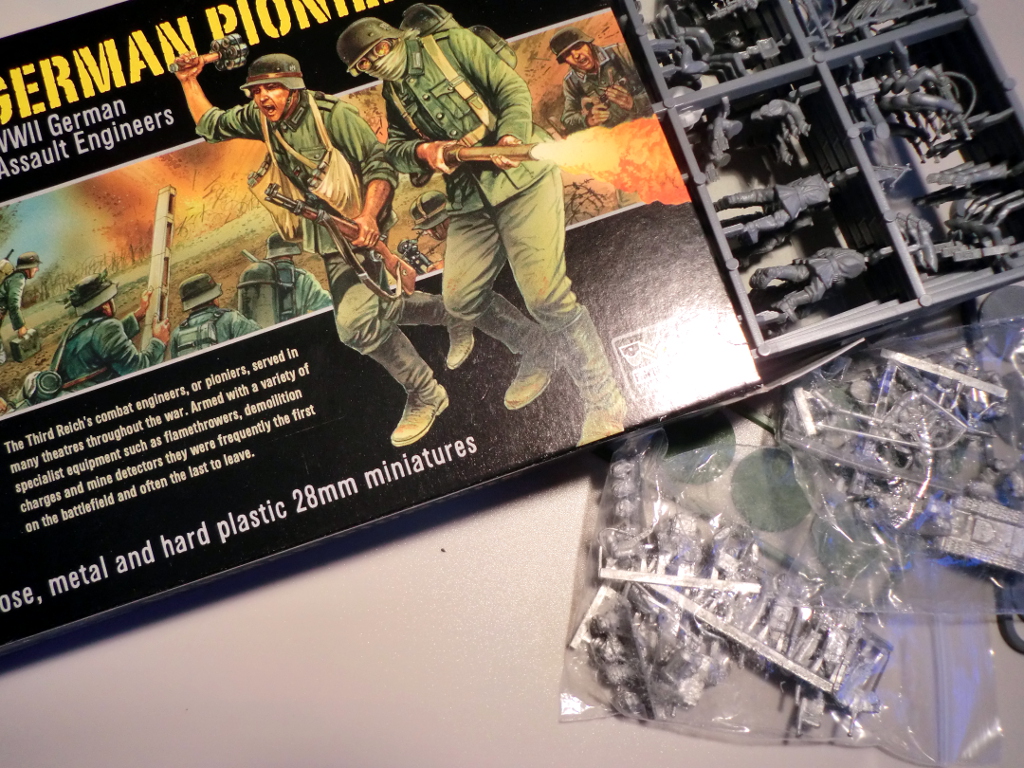
German Pioneers, or assault engineers.
A box of German assault engineers, pioneers, or Sturm Pionier.
Opening the box reveals a lot of plastic frames and two zip-lock bags with metal bits.
The box contains 31 plastic and metal miniatures, allowing you to build german assault or combat engineers. These were highly trained, highly motivated and heavily equipped assault troops as well as regular field craft specialists. They operated in their own platoons or companies within an infantry regiment, often spearheading an assault.
For some reason I only got 20 Renedra bases and five Warlord bases... for 31 figures!
So what do I think about this set? You get a lot of stuff, right? No... not quite. Or yes you do, but most of it is not stuff that is useful for pioneers. Useful for regular infantry yes. Incidentally the price difference is only £2 between the sets and they contain the same number of sprues, making the Pioneer set a very good buy if you are after regular infantry because of all the extra bits you get.
I got a raise at work, retroactively six months back, so I decided to splurge on some toys from Warlord Games. I originally intended to buy a Sarissa Precision mansion in MDF, but it was out of stock, so I just randomly added stuff to the basket until I felt content. Well, not entirely random, but almost, since my original plan was foiled.
I couldn't resist picking up a Warlord Games Hanomag at Gothcon last month. This is a plastic kit of the famous german halftrack, Sd.Kfz 251 (the funny little letters just mean special motor vehicle) ausf. C (the third version which was used roughly between 1941 and 1944). It features a riveted hull which was later changed to being welded which makes it more suitable for the earlier period. This is perfect for using with my DAK which currently lacks any transports.
The shape is accurate enough, but the details are a bit crude.
At the end of the last post the basic paint job on the Cromwell was done; shading and highlighting of the main hull and turret completed. Details like the tracks and tools lacked paint however, and the application of markings and weathering was also left. Since I foolishly had left the top hatch open I also needed to paint a commander.
Returning from GothCon (more about that in a later post) I was a bit tired of all the desert stuff. For relaxing I decided to build and paint the 28mm Italeri Cromwell I bought a while back.
Coffee, plastic glue and a sharp knife equals happiness. (Note funky Mutant: Year Zero dice on the left)
Assembly was straight forward. It's a good kit, although the instructions tell you to cut the driver's hatch in half if you want to assemble it open, when in fact the hatch already is in two parts on the sprue. Even though it's fast build there are some nice details like the headlamp guards on the hull, the possibility to leave hatches open and the optional Cullin hedgerow cutter.
Now it's very green.
As I've said in previous posts I like building more than painting, so I was going to try some fast painting techniques to save time. To begin with I undercoated the model entirely with rattle spray cans. First it received a shot of black on the underside and sides from a low angle. Then I sprayed Flames of War Soviet Armour from a higher angle, and last -- still using a rattle can -- I used Army Painter Army Green directly from above to form highlights.